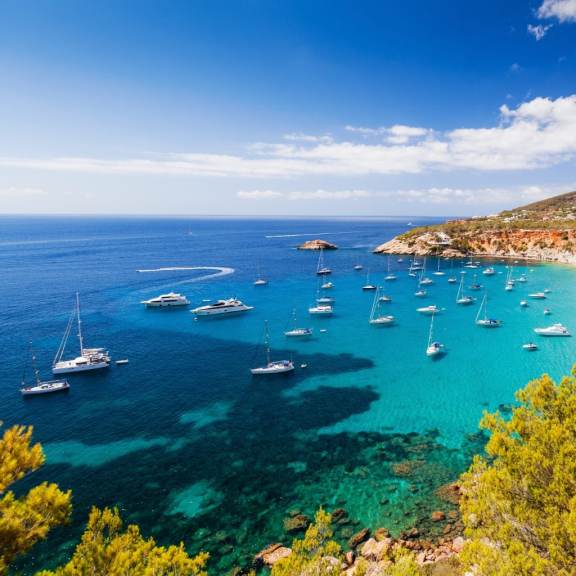
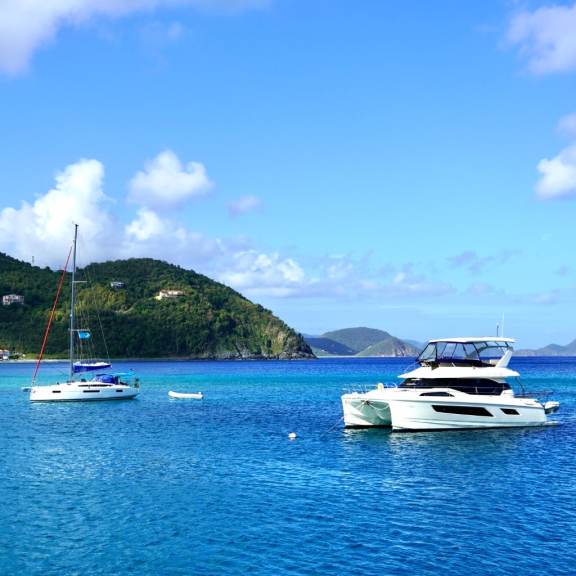
There are three ways to charter a yacht. Bareboat, where you run the boat yourselves. Skippered, where a professional drives it. Crewed, where a captain, a chef and often a third crew member run the whole week for you.
If you typed “do we need a skipper” into Google, here is the short answer: a skipper takes the boat off your hands, not the housekeeping. You still shop, cook, do the dishes and plan every day. Crew is where the vacation starts running itself.
We sell all three, and bareboat is a real lane for us. But the gap between skippered and crewed is far bigger than the price gap suggests. Here is what you actually get at each level.
The three tiers in one minute
- Bareboat: the yacht, and only the yacht. You sail it, provision it and look after it. From around $10,000 a week on our books.
- Skippered: the yacht plus a licensed skipper who handles the boat. Cooking, cleaning and day planning stay with you. From about $15,000 a week.
- Crewed: the yacht plus a crew whose only job is your group. Meals, cabins, route and toys are all handled. From $15,000 to $130,000 and beyond per week.
Bareboat: the boat is yours, and so is everything else
What you get: the yacht itself. Hull, sails or engines, tender, linens and a briefing at the dock. Then the base hands you the keys and the week is entirely your own. You pick the anchorages, you decide when to leave, and nobody is aboard who is not part of your group.
What you do yourselves: all of it.
- The route, the helm, anchoring, mooring pick-ups and docking.
- The shopping run and the provisioning order.
- Cooking, the dishes, the cabins and the trash.
- Fuel and water top-ups.
- Check-in and check-out with the base.
What it costs and how: the headline rate covers the boat. On top you pay for provisioning, fuel, moorings and cruising fees, plus a security deposit or a damage-waiver premium that reduces it. There is no crew, so there is no gratuity to budget.
For real numbers, one BVI base, BVI Yacht Charters, publishes a $1,500 to $3,500 deductible by boat length, a $50-a-day damage waiver capped at $500, provisioning packages of $18 to $35 per person per day, and a $4 per person per day cruising tax.
You also need to satisfy the base that you can run the boat:
- BVI: no license, just a sailing resume showing experience on a similar vessel.
- Greece: the skipper needs an ICC or equivalent.
- Croatia: a recognized skipper license plus a VHF certificate.
- Anywhere else: ask us for the rules in your area.
Who it suits: groups with a confident sailor among them and the appetite to run the boat. It is also the tier with the lowest all-in number for a big group, because there is nobody to pay or feed beyond your own party.
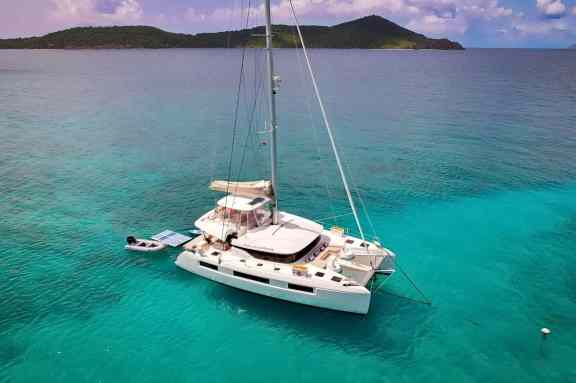
Skippered: someone drives, you still run the vacation
What you get: a bareboat plus one professional who takes the boat off your hands. Your skipper handles:
- Navigation, the helm, anchoring, mooring pick-ups and docking.
- The dinghy, the safety briefing and the boat’s systems.
- The weather, and the timing that gets you into an anchorage before it fills.
A hostess is the optional second hire. She takes the daily cleaning, serves meals and drinks, and keeps the boat organized. She is not a chef unless the boat books her as one.
On the small Croatian motor yachts that run a captain and a hostess, the operator’s own notice to our brokers promises a light breakfast and one simple cooked meal a day, with dinner ashore. Read the terms for the boat you are looking at.
What you do yourselves: everything inside the boat.
- The provisioning list, the shopping and the bill for it. Some owner-run boats in the BVI will order it in from the list you write.
- Cooking. The skipper does not cook.
- Cleaning, the dishes and the trash, unless you add a hostess.
- Planning what you want from each day. The skipper works out how to make it happen.
- Feeding the skipper, and a hostess, from your stores.
What it costs and how: skippered charters start from about $15,000 a week. That is the bareboat rate plus a skipper hired by the day, plus their food. In the BVI, BVI Yacht Charters lists a regular captain at $300 a night and an instructional captain, who teaches as you go, at $350.
Med skipper rates vary by base, so ask us for the boat you have in mind.
Ask where the crew sleep. Some charter catamarans carry a crew berth in the bow. Without one, the bareboat fleets give the skipper a guest cabin of their own, and a hostess needs a berth too. That turns a four-cabin catamaran into three cabins for guests, or two with a hostess.
The tip works on the crew’s fee, not on the boat. Our brokers’ guide is 10 to 15 percent of the skipper’s fee, and the same for a hostess, so it is a fraction of what the same percentage on the boat’s rate would produce.
Who it suits: groups who want the sailing handled and are happy to keep house, and anyone whose sailing resume falls short of what the base wants. In the BVI, if you have not sailed a catamaran before, expect the supplier to suggest a skipper or a checkout captain.
To see what this looks like in practice, browse the ten yachts our brokers actually book with a skipper in Croatia and in Greece, from about €12,000 a week.
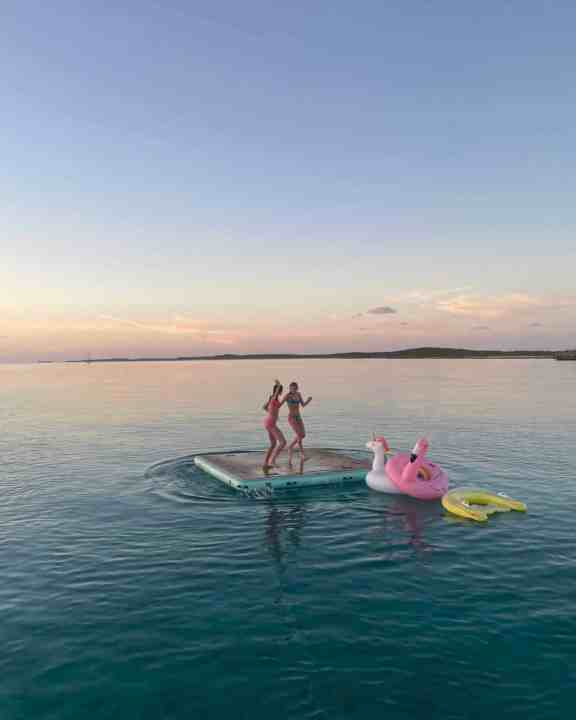
Crewed: the vacation runs itself
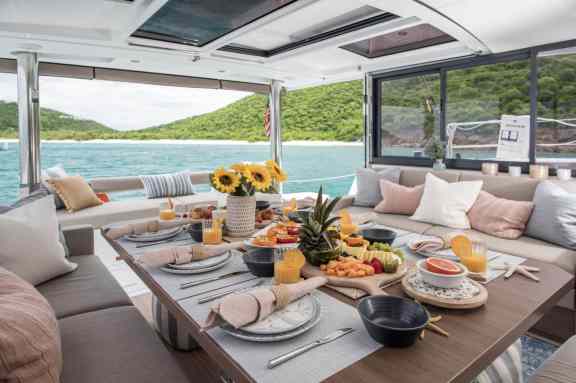
What you get: one weekly fee for the yacht and a crew whose only job is your group. The crew provision from your preference sheet before you arrive, cook every meal to your taste, turn the cabins, run the tender, launch the toys and plan the route around what you want each day.
The crew also belongs to the boat. Mo Pristas, on camera for our Greek site, puts it at about EUR 15,000 for a Greek catamaran before you get a crew that is stable with the boat, rather than a bareboat with a crew that showed up for the week and cooks and drives around.
What you do yourselves: nothing you do not want to.
- Fill in the preference sheet: food, drinks and the kind of week you want.
- Tell the captain what matters to you, and let the route follow.
- Get up when you like. Breakfast is served when you appear, the boat moves to the next bay while you eat, and the evening ends when you say it does.
What it costs and how: fully crewed yachts on our books run from $15,000 to $130,000 and beyond per week. On our own lists that looks like crewed BVI catamarans from $16,500 to $32,700 a week for six to eight guests, and Greek motor yachts from EUR 20,500 to EUR 40,320 for eight to ten.
The rate normally excludes VAT, gratuity and the expense allowance that pays for fuel, food and berths. Crewed boats price one of two ways:
- All-inclusive: one number covers the yacht, crew, meals, standard bar, fuel for a normal route and the listed water toys. Most crewed catamarans in the BVI are sold this way.
- Plus expenses: a base fee plus an advance provisioning allowance, usually 25 to 30 percent and higher on motor yachts, spent at cost with the unspent balance returned.
A tip is always at your discretion. The MYBA agreement does not require one, it is never charged up front and nobody asks for it. The custom is 5 to 15 percent of the base fee in the Mediterranean and 15 to 20 percent in the Caribbean.
It is worked on the base fee, never on VAT or the expense allowance, handed to the captain on the last day and shared across the crew.
Who it suits: anyone who wants the week to be a vacation for every person aboard, including the one who would otherwise be cooking. See five crewed BVI catamarans we rate a step ahead, from $16,500 a week, or ten crewed motor yachts in Greece under EUR 40,000 a week.
How many crew: three is the turning point
Our crew ladder comes from watching it play out boat by boat in the BVI. The full version is in how many crew you need on a BVI yacht charter; here is the short one.
- 2 crew, a captain and a chef: the minimum for a charter to count as crewed at all. The captain runs the boat and the chef does everything else: cooking, cabins, drinks, and launching the paddleboards. When one person is plating lunch, nobody is refilling drinks.
- 3 crew: going from 2 to 3 crew is the single most important upgrade you can make. The third crew member, usually a dedicated stew, is the first person aboard whose entire job is you. The chef stays in the galley, the captain stays on the helm, and someone is finally free to serve.
- 4 crew: better. Captain, chef, stew and deckhand. While the captain is on the helm the stew is making cocktails, and the moment the anchor drops the deckhand has the water toys in the water.
- 5 crew: pure luxury. It usually means a second stew, so dinner for eight is served by two people at once, with no gaps.
The third crew member is a smaller step in price than in service. On our BVI post, adding one to a boat that allows it can be around $2,000 for the week, and some three-crew catamarans there price right alongside two-crew boats of the same size.
The captain of PURPOSE, a three-crew catamaran on our BVI channel, says on camera that the third crew member lets the chef focus only on the food, and lets someone spend time on the water with the kids while he concentrates on the sailing.
Crew count is capped by crew cabins. A 55-footer cannot simply add crew, because there is nowhere for them to sleep. And more crew is not automatically better: crew quality beats headcount, which is exactly what we track boat by boat.
What actually changes when there is a crew
- Who cooks. Bareboat and skippered: you, from a list you wrote and shopped for. Crewed: the chef, from a preference sheet you filled in before you arrived. With three crew, the chef’s whole job is the food.
- Who plans the day. Bareboat: you, with the chart and the forecast. Skippered: you decide what you want, the skipper decides how to make it work. Crewed: you say what kind of week you want and the captain builds it around you.
- Who cleans. Bareboat and skippered: you, unless you add a hostess. Crewed: cabins are turned around while you are ashore or at the table, and you leave your plate.
- Who is with the kids. Bareboat and skippered: a parent, every time. On the bareboat fleets, childcare sits on the published list of things the skipper is not there for. Crewed: from three crew, someone can be on the paddleboards with the children while the chef cooks.
- The evenings. Bareboat and skippered: someone cooks, everyone does the dishes, or you all go ashore. Crewed: dinner is served on deck, then the deck is yours, and the guest fridge is yours at midnight.
- While the boat moves. Bareboat: someone is on the helm and someone is on the lines. Skippered: the skipper sails and you help if you feel like it. Crewed: you are on the bow with a drink.
Bareboat is a different vacation, not a lesser one, and for a group that loves sailing, running the boat is the point. But if the person who ends up in the galley is the person the trip was meant to treat, that is the case for crew.
Which one is right for your group
- Sailors who want to sail: bareboat, or skippered if your resume is thin on catamarans. The boat starts from around $10,000 a week, with provisioning, fuel and fees on top.
- Eight guests, under $20,000 all-in: bareboat. When one of our brokers priced eight guests at $18,000 all-in in 2026, the only candidates were bareboats, and even that was a tight fit. At about $25,000 all-in, crewed options opened up.
- Sailing handled, happy to keep house: skippered, from about $15,000 a week, with a hostess if nobody wants to clean. Budget the skipper by the day, their food, a cabin, and 10 to 15 percent of their fee as a tip.
- First or second charter, and you want the week to run itself: crewed, from $15,000 on our books. Two crew delivers a happy week for couples and small groups who eat ashore most nights. If service matters to you, start at three crew.
- Ten to twelve guests: at these budgets, a five- or six-cabin catamaran run bareboat or skippered, or a five-cabin crewed catamaran with two crew. Four crew and up is the step up for a watersports-heavy week, and five when you want it effortless from the first drink to the last.
Where the tiers overlap, the destination decides. At $20,000 in the BVI, six guests are already in crewed territory: two-crew catamarans on our list start at $16,500 all-inclusive. In Greece the same money is closer to the line, and one of our files shows why.
Price the crewed option before you assume it is out of reach. Here is that Greek file from 2023, in euros, the same catamaran both ways:
- Skippered build: about EUR 8,900 for the bareboat, roughly EUR 2,500 for a skipper and hostess for the week, their food, and a tip of about EUR 250 on their fee. It came in under EUR 15,000.
- Crewed build: about EUR 10,800 for the same boat with her own crew, plus hostess and VAT, closer to EUR 16,000. The tip is worked on the base fee here, so it is larger too.
Around a thousand euros apart before the tip, for a crew that belongs to the boat instead of two people meeting it on Saturday. Our brokers have watched that sum play out on other files: the bareboat rate looks cheaper on paper, then the skipper, the hostess and their meals narrow the gap.
Tell us the group, the dates and the number you want to stay inside, and we will price the same week both ways, skippered and crewed. Send us an inquiry. You get one week a year on the water. Let’s make it count.
People also ask
Do I need a skipper for a yacht charter?
Only if you cannot show the base you can run the boat, or you would rather not. In the BVI no license is needed, but the base asks for a sailing resume with experience on a similar vessel. Without catamaran experience, expect them to suggest a skipper or a checkout captain.
Do I need a license to charter a bareboat?
It depends on the destination. In the BVI no license is needed, just a sailing resume. In Greece you need an ICC or equivalent, and bases also ask for a second competent adult on the crew list. Croatia asks for a recognized skipper license plus a VHF certificate. Ask us about any other area.
What does a hostess do on a skippered charter?
Daily housekeeping, serving meals and drinks, and keeping the boat organized. A hostess is not a chef unless the boat books her as a cook. On the small Croatian motor yachts that run a captain and a hostess, that means a light breakfast and one simple cooked meal a day, with dinner ashore.
How many crew do I need?
Two, a captain and a chef, is the minimum for a charter to count as crewed. Three is the single most important upgrade, because the chef stays in the galley while a third crew member serves. Two suits couples who eat ashore; four and up suits big groups and watersports-heavy weeks.
Is the skipper included in the price?
On a skippered charter, usually not: the skipper is added to the bareboat rate by the day, plus food and a cabin. Some owner-run catamarans quote one number with the captain included, so ask. On a crewed yacht the crew is inside the weekly fee; VAT, the expense allowance and the tip are separate.