You do not sail the boat, cook, or plan the days on your own. On a crewed catamaran the captain runs the boat, the crew run the week, and your job is deciding what kind of week it is.
The thing first-timers get wrong is picturing a cruise. A crewed catamaran is a private boat with 2 to 4 people working on it, and it bends to your group: when you eat, where you stop, how late the evening runs.
The short version:
- Who does what: the captain drives and decides what is safe; the chef or hostess feeds and hosts you; a deckhand, on bigger catamarans, runs the tender and toys.
- The shape of a normal day: anchor up mid-morning, 2 to 3 hours moving, lunch and a swim at anchor, a new bay by mid-afternoon.
- The 2 things that decide everything: the preference sheet you fill in before boarding, and the captain’s briefing on day 1.
- What the crew do while you are not watching: provisioning, cabins, laundry, weather, tomorrow’s route.
Everything before boarding, from inquiry to contract, is in our guide to how a first yacht charter works, and the differences between bareboat, skippered and crewed charters are in our comparison. This article starts where those end.
1. Boarding day
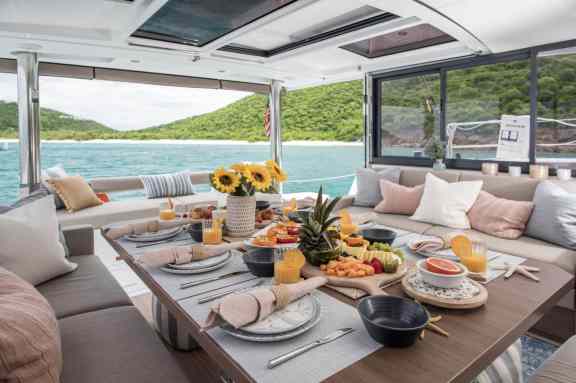
In the BVI most crewed catamarans board at noon, and lunch is the first meal the crew serve. In Greece and Croatia boarding is late afternoon, usually 5 pm, and dinner is the first meal. The hour is in your contract, so check it before you plan the day.
The first hour is welcome drinks, cabins and the safety briefing. Then the captain sits down with the whole group and goes through the preference sheet in person, with the week’s weather and a first sketch of the route.
Day 1 is a short hop or staying put, because permits need clearing and provisions need stowing. In the BVI, when you board in the USVI, the crew usually handle customs while you stay aboard. Use the meal before boarding to agree on the 2 or 3 things everyone wants from the week.
2. Who does what on board
Their job is you, and by the first evening it feels normal. A catamaran for 4 to 10 guests runs on 2 or 3 crew, 4 on the bigger 60-to-70-footers. The captain drives, reads the weather, anchors, docks and has the final word on safety, including when the paddleboards go in.
The second crew member is a chef or a hostess, and on a 2-crew catamaran that is 1 person: cooking, cabins, drinks, dinghy runs. A third crew member takes the serving and the toys off the chef.
On a crewed catamaran every crew member looks after guests, the captain included. If a listing shows 3 crew and only 1 of them hosts, ask your broker why.
The crew have their own cabin, often a berth in the bow, sometimes a cabin of their own in one hull, and they take their meals at their own times, apart from you. Once dinner is cleared they disappear, and they are up before you.
3. A normal day
The anchor comes up between 9 and 10; breakfast comes out when the first person surfaces, not on a bell. The boat then moves for roughly 2 to 3 hours: the next island or the next stretch of coast. In the BVI the hops are shorter.
Lunch is at anchor, in a bay picked for the water rather than the restaurant. The middle of the day is swimming, paddleboards and a nap on the trampoline. The boat reaches the night’s stop between 3 and 4, early enough to walk a village or do nothing off the back steps.
Dinner is on deck around 8, unless the plan is a taverna or a beach bar. The crew set the timing around wind and weather, not a printed schedule. A breeze due at noon means an earlier start; a flat afternoon means lunch runs long.
4. Who decides where you go
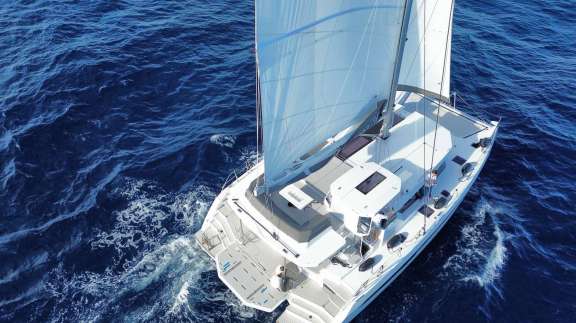
The route starts with your preference sheet: the places you want to see, how much moving you can stand, lively harbors or empty bays. The captain builds each day from that the evening before, usually over dinner, and tells the group what tomorrow looks like.
Weather overrules everyone, the captain’s own plan included. A 25-knot forecast in the Cyclades or a north swell in the BVI turns a crossing into a sheltered day, and a captain who says no to a crossing is doing the job.
How to ask for a change: the night before, not at breakfast. Fuel, provisioning, a booked berth and the wind sit behind tomorrow’s plan, so a request at 8 pm is a route change and the same request at 9 am is often a no.
5. Meals, drinks and the galley
The main provisioning run happens before you board, from the sheet. The chef shops the week around what you wrote down: coffee the way you drink it, the brand of gin, the kids’ cereal.
If it is not on the sheet, do not expect it aboard on day 1. A mid-week restock in the BVI, usually at Spanish Town or Road Town, gets you the basics, not the brand you named.
A catamaran galley is a home kitchen with a smaller fridge, and on most catamarans it sits in the saloon, so the chef cooks in your space.
One person can run 3 meals a day for 8 to 10 guests well, but not 3 courses at 3 sittings and not a menu per guest.
I am vegan, and I say so at every show lunch and fam trip, then watch what the galley does. The good chefs answer with a menu, not a shrug.
Put every allergy and diet on the inquiry, not just the sheet: your broker confirms the chef can cook it before you sign, so nobody finds out on day 1. Some chefs decline strict ones, and a good broker keeps asking until one says yes.
On all-inclusive Caribbean boats the ship’s bar is in the price: house wine, beer, soft drinks and the standard spirits. Premium labels and a specific champagne are ordered at cost. On plus-expenses boats in Greece and Croatia, drinks come off the APA, the expense allowance the captain holds.
Dinners ashore are yours to pay. Most groups take 1 or 2 a week because the town is the point, not because the galley cannot manage, and the crew will book the table.
6. Nights
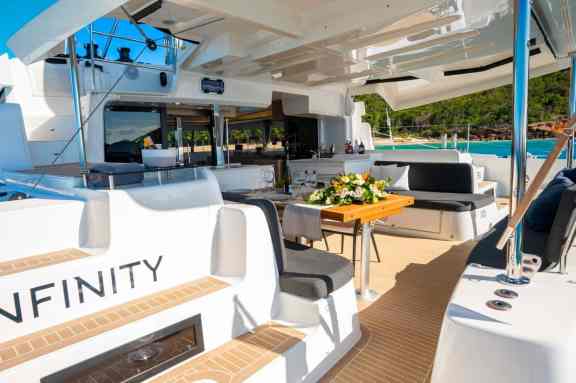
In the BVI nights are on a mooring ball or at anchor, and the mooring ball is the default: the boat clips on, the generator runs for the air-conditioning into the evening, and the bay goes quiet.
In Greece nights alternate between a quiet bay at anchor and stern-to on a village quay, and the bay is the version to want.
In Croatia the pattern flips: town nights are common because the old towns are the point. The captain gets in early to claim a berth, since most old-town quays do not take bookings and only the marinas do. Berths go on the APA; you feel less movement and hear more of the harbor.
Does it rock? At anchor in a sheltered bay a catamaran barely moves; 2 hulls make it noticeably steadier than a monohull. In a swell you will feel it, and a captain will move the boat if a bay turns uncomfortable, sometimes at dawn while you sleep.
Not every catamaran runs its air-conditioning all night, and in August that matters, so ask before you book. How long the generator runs is decided boat by boat, and the captain will tell you on day 1.
7. The last morning
In the BVI most contracts have you off by noon, though the crew may ask for 10. In Greece and Croatia disembarkation is 9 am, so the crew can turn the boat around for the next group. The hour is in your contract, so check it before you book flights.
On a plus-expenses boat the APA is settled with the captain the last evening or that morning, line by line, with any remainder refunded or, if you choose, signed over toward the tip. On an all-inclusive boat there is nothing to settle.
The tip is your call, and no contract asks for it. As a custom, crews in the Mediterranean see 5 to 15 percent and crews in the Caribbean 15 to 20, worked on the charter fee and handed to the captain for the whole crew. The rest is in our crewed charter etiquette guide.
What people wish they had known on day 1: that the preference sheet mattered more than the brochure; that the captain would have said yes to a slower week if asked; that soft bags stow and hard suitcases mostly do not; and that the crew are not watching you, they are working.
Send us an inquiry with the group, the dates, the destination you are leaning toward, and the one thing you most want to avoid. We will match you with a catamaran and crew that fit, and start the preference sheet early. To browse first, our crewed catamarans are listed by destination and guest count.
People also ask
Do I need any sailing experience?
No. On a crewed catamaran the captain holds the license and the responsibility, and no guest is expected to steer, anchor, handle lines or read the weather. If you want to take the wheel on a calm afternoon, most captains are happy to show you; if you never touch anything all week, nobody will notice.
Can we change the route mid-week?
Yes, and many groups do. Tell the captain the evening before, not over breakfast, because fuel, provisioning and booked berths sit behind each day. Staying an extra night somewhere you love is the easiest change there is; adding a long passage in August wind is the one that may get a no.
Is it awkward having crew aboard?
It is one of the worries we hear most before boarding, and we rarely hear it after. On a 45 to 60 foot catamaran the crew are close, but they are working, not watching. They eat apart and vanish after dinner; after the first full day most groups stop noticing where they are.


